
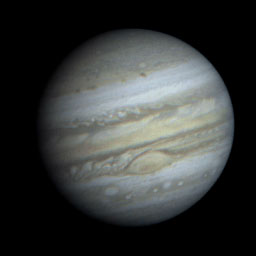
Jupiter is the fifth most distant planet in our solar system. Jupiter is the largest planet in the solar system and is more than twice as large as all of the other planets in the solar system combined, and 318 times as big as earth. Jupiter has an orbit of 778,330,000 kilometers or about 475,000,000 miles this distance is approximately 5.2 AU, which stands for astronomical unit. One astronomical unit is the distance that the earth is from the sun, so the earth is exactly 1.00 AU from the sun. Jupiter's diameter is 142,984 kilometers (87,200 miles) compared to the earth's diameter of about 7600 miles. Jupiter also has the largest mass in the solar system (other than the sun) of 1,900,000,000,000,000,000,000,000,000,000 kilograms.
Jupiter is named for the Greek god Zeus also known as Jove. Jupiter is the brightest object in the sky other than the Sun, the Moon and Venus although Mars can be brighter at some times. Humans have known of Jupiter's existence since prehistoric times. In 1610 the astronomer Galileo discovered four of Jupiter's moons; Io, Europa, Ganymede and Callisto. These moons are now called the Galilean moons. At the time of this discovery any opinions opposed to the Catholic Church were punishable and since the church did not support Galileo's theory he got into some trouble.
In 1973 the Pioneer 10 spacecraft visited Jupiter. Pioneer 11, Voyager 1, Voyager 2 and Ulysses have also visited it. Galileo, a more recent spacecraft, is currently orbiting Jupiter and is currently sending back data about the planet. Gas planets, which include Jupiter, Saturn, Uranus and Neptune do not have a solid surface as we think of a planet being. Instead their surface is simply gas that gets denser with depth. So on the "surface" it may not be much more dense than air but as you travel towards the center it gets more dense until it is like a liquid and then in further it becomes a solid because it is compressed by the gravity so much. When you look at a gas planet you do not see the surface, instead you are looking at clouds of gas.
Jupiter is about 10% Helium and 90% Hydrogen it also contains a very small amount of methane, water and ammonia. Jupiter may also contain a core of rock that is 1000%-1500% larger than the earth. Above the core of rock Jupiter contains liquid hydrogen. Liquid hydrogen can only be formed at very high pressure.
Gas planets like Jupiter have very high-speed winds that flow laterally over the surface. The bands on Jupiter are caused by wind moving opposite directions and different speeds. These different speeds cause different temperatures, which cause different colors. The dark colored bands are called belts while the light colored ones are called zones. The swirling vortices where winds meet were not discovered until the Voyager mission. The winds on Jupiter blow as hard as 400 miles per hour.
The interior of Jupiter is approximately 20,000 Kelvin. This heat is not produced by fusion as on the sun but rather by the Kelvin-Helmholtz mechanism. This is where the gravity slowly compresses the planet and causes the atoms to gain energy, which increases the kinetic energy in the atoms, which causes heat. And you can not light Jupiter on fire and create a second sun as in the movie 2010, because it does not contain any oxygen.
Jupiter's rings were not known about until the '70s when Voyager 1 caught a picture of them. They are not nearly as fantastic as Saturn's. They have since been observed from Galileo and infrared telescopes. Jupiter's rings are dark unlike Saturn's. They contain small particles of rock.
Jupiter's enormous gravitational field helps protect earth from meteors as in the 1994 Comet Shoemaker-Levy 9. This comet would have most definitely destroyed the earth if it had hit it. This only protects us if the comet is coming past Jupiter.
Jupiter has 39 known moons but only 12 have been named. More than likely Jupiter has more moons that have not been observed. Jupiter's moons are named for figures in the life of Zeus.
