
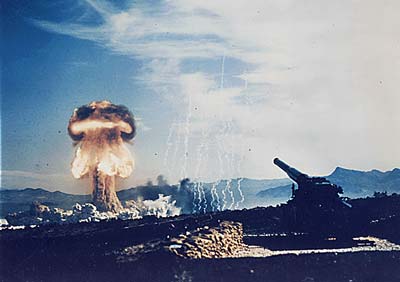
Nuclear weapons are the most devastating device that humans have ever created, they have changed our world and how countries enforce their foreign policies. It has been estimated that up to 40 countries are currently capable of manufacturing nuclear weapons and at least 10 acknowledge of possessing them. [New Book of Knowledge, 1996] In this report I will attempt to explain the different types of nuclear weapons, how they are made and the devastating effects that result from their use.
The first nuclear bomb, a product of the Manhattan project, was detonated July 16, 1945 near Alamogordo New Mexico. The Manhattan project was the United States’ top-secret program to develop nuclear weapons for use in military action. Top scientists worked around the clock to develop such a bomb before the German army was able to develop a similar device. The Manhattan project was classified for many years and only recently has substantial information come out about the vast amount of work that was accomplished. [Bracchini, 1997]
The first step that the Manhattan team had to solve was what fuel should power the bomb. It was necessary to find a fuel that could sustain a chain reaction, two possible fuels were chosen, Uranium 235 (U235) and Plutonium 239 (P239). Both of the selected fuels are isotopes of the elements Uranium and Plutonium and can sustain a chain reaction, however both are very rare and must be refined out of the raw elements to achieve a much more pure form. [New Book of Knowledge, 1996] In the case of Uranium 99% of the ore is made up of Uranium 238, which is worthless in making a bomb, some of the remaining 1% is Uranium 235, which can sustain the chain reaction necessary. [Bracchini, 1997]
Now that fuels had been discovered the scientists had to put it to practical use. They created a fission bomb that used the Uranium 235 isotope. Fission is the process of breaking heavy-element atoms into smaller pieces, it occurs when a neutron strikes the nucleus of a fissionable material. [Britannica, 1995] When this happens it breaks apart the nucleus, which in turn releases more neutrons that strike the nucleuses of other atoms surrounding them. This starts a self-sustaining chain reaction. Along with neutrons this reaction releases gamma radiation and massive amounts of energy. The result of this chain reaction is a nuclear explosion. [World Book, 1999]
In order for the fission reaction to start a critical mass must be achieved from a sub-critical mass. A critical mass is the minimum amount of fissionable material required to sustain a chain reaction, a sub-critical mass is too small to sustain such a reaction. [New Book of Knowledge, 1996] In a bomb it is desirable to achieve a supercritical mass, which is more than enough fissionable material to sustain a chain reaction. A supercritical mass results in a rapid self-sustaining chain reaction. There are two common methods of obtaining a supercritical mass that have been used. [World Book, 1999]
The first method to achieve a supercritical mass is the gun method. In the gun method a spherical “target” of enriched Uranium 235 is located at the end of a barrel and a wedge of Uranium 235 is located at the other end of the barrel. The sphere has a void the exact same size and shape as the wedge, this is where the wedge will be fired at. When the bomb detonates, conventional explosives packed behind the wedge propel it down the barrel very rapidly into the Uranium sphere, upon impact a supercritical mass is achieved and the chain reaction will occur with in one millionth of a second. [New Book of Knowledge, 1996] Very large amounts of energy are released. The Little Boy bomb dropped on Hiroshima was an example of a gun type fission bomb.[World Book, 1999]
The second method to achieve a supercritical mass is the implosion method. In the implosion method a sphere of Plutonium 239 is located in the center of conventional explosives. When an implosion type fission bomb is detonated the conventional explosives squeeze the Plutonium core in on itself to achieve a supercritical mass. Implosion type bombs have been proven to have higher yield than gun type bombs. [Britannica, 1995] Yield is the amount of energy released from a bomb. The Fat Man bomb dropped on Nagasaki is an example of an implosion type fission bomb. [World Book, 1999]
A second and much more powerful type of nuclear bomb is the fusion bomb commonly known as hydrogen bombs. In fusion bombs Hydrogen isotopes tritium and deuterium are fused together to form a helium nuclei, this process produces a small amount of matter but a massive amount of energy. [Britannica, 1995] Temperatures in excess of 27,000,000ºF must be achieved in order to start a fusion chain reaction, the only way to achieve such high temperatures is to detonate a fission type bomb that then detonates the fusion bomb. An average Hydrogen bomb has a yield of around 20 megatons (20,000,000 tons of TNT) which is equal to 1540 Little Boy bombs dropped on Hiroshima. The most powerful Hydrogen bomb ever made had a yield of over 60 megatons. [World Book, 1999]
All three types of nuclear weapons have devastating effects. There are four main types of damage that nuclear weapons inflict, the blast wave, thermal radiation, initial nuclear radiation, and residual nuclear radiation. The blast wave is the shock wave created by the expanding gasses released from the explosion, it can travel up to 400 miles per hour, which allows it to travel over 12 miles in 50 seconds. The blast wave causes most of the damage that the bomb does. A one-megaton bomb’s blast wave will destroy most buildings within a one-mile radius of ground zero and can cause severe damage up to 6 miles away, it also can cause second degree burns up to 11 miles away. [Freudenrich, Online] Thermal radiation is composed of ultraviolet, visible, and infrared radiation. The UV radiation is quickly absorbed by the surroundings and causes little damage. Visible light and infrared radiation causes eye damage and severe flesh burns. Approximately 30% of all deaths caused by nuclear weapons are from flesh burns.
Initial nuclear radiation is given off within the first minute after the explosion and consists of neutrons and gamma rays. The neutrons are given off instantly when the bomb explodes while the fireball gives off the gamma rays. The gamma rays cause swelling, destruction of cells, and prevent normal cell replacement. Residual nuclear radiation is given off later than one minute after the explosion, gamma rays and beta particles are given off from fission bombs and neutrons are given off from fusion bombs. This radiation causes other objects to become radioactive such as water, soil, and rocks. Within the first 24 hours heavy fallout comes down, this type is highly radioactive. Delayed fallout can occur years after the explosion but are very tiny particles. [World Book, 1999]
There are two main types of nuclear weapons, strategic nuclear weapons and theater nuclear weapons. Strategic nuclear weapons are capable of long-range destruction through delivery methods such as airplanes and intercontinental ballistic missiles. These types of bombs are designed to be able to destroy military assets at a very long range. Theater nuclear weapons are designed to be used within a theater of war, delivery systems for theater nuclear weapons are generally medium range guided missiles or cruise missiles. Other delivery methods include unguided rockets, artillery shells, mines and torpedoes. [World Book, 1999]
Freudenrich, Craig C. How Nuclear Bombs Work. 18 Dec. 2003
http://www.howstuffworks.com/nuclear-bomb.htm.
"Nuclear Weapons." Academic American Encyclopedia. N.p.: n.p., 1994. pg 596.
"Nuclear Weapons." The New Book of Knowledge. N.p.: n.p., 1996. pg 820.
"Nuclear Weapons." The New Encyclopedia Britannica. N.p.: n.p., 1995. pg 289.
"Nuclear Weapons." The World Book Encyclopedia. New York: n.p., 1999. pg 374.

Bibliography
Bracchini, Miguel A. The Manhattan Project. 30 Apr. 1997. 18 Dec. 2003
http://www.me.utexas.edu/~uer/manhattan/.
Top Home
Last updated on May 16, 2004 at 8:54pm Central Standard Time