
THE HUMAN NERVOUS SYSTEM
TITAN MILLER
This report is about the human nervous system and what role it plays in the human body. This will explain how each of the five senses work and how nerves control your muscles. This will also go over several diseases and disorders of the nervous system. If it were not for your nervous system your body would not be able to survive because nerves control all of your organ systems.
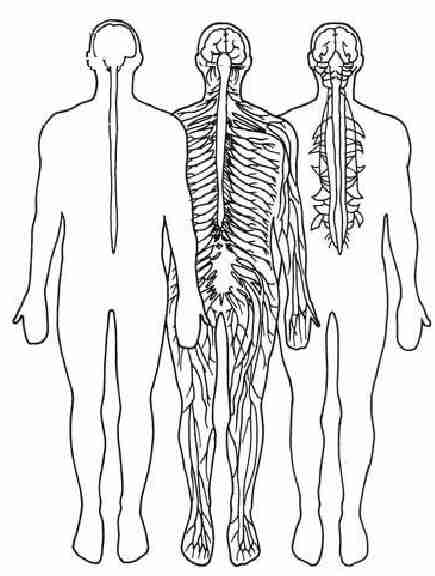
The nervous system can be broken down into the central nervous system and the peripheral nervous system (Bakewell, 1995). The central nervous system is composed of the brain and the spinal cord. The brain is either the sender or receiver of all neural impulses sent through your nervous system (Anon. 8, 2002). It controls all of your body's voluntary and involuntary muscular movements. The spinal cord is the main nerve that runs through the center of the vertebral column. All peripheral nerves, including the autonomic, lead to the spinal cord so that they can be transmitted to the brain (Anon. 8, 2002).
The two primary functions for the nervous system are to control muscle actions and to give the body the ability to sense its surroundings. Sensory nerves handle the impulses from the environment and carry them to the central nervous system. Motor nerves send signals from the central nervous system to control muscle movement (Anon. 9, 2002). Your body controls muscles by sending signals along a very large network of nerves, these electrical bursts are called nerve impulses (Anon. 9, 2002). Nerves are negatively charged because there are fewer negative ions outside it than inside it (Anon. 8, 2002). When the nerve impulse reaches the nerve it reverses the charge and becomes conductive. When the impulse reaches the end of the tubular part of the nerve cell it enters a large part at the end of the cell where the impulse is transmitted to the next cell. The nerve cells do not touch each other; there is a gap between each cell. A chemical called neurotransmitter passes the message from one cell to another (Anon. 9, 2002).
If you want to bend your left knee your brain must send many impulses down the spinal cord. When the impulses reach the correct spinal nerve it leaves the spinal cord and travels outside of the vertebral column. This nerve then travels toward your left leg and branches off again. This nerve travels to the correct muscle stimulating it to bend your leg at the knee. In actuality the signal would branch off more times though before it reaches the correct muscle (Anon. 9, 2002). The elapsed time from the signal being sent from the brain until it reaches the destination is between 3 and 120 milliseconds (Anon. 9, 2002).
The sensory nerves also known as afferent nerves carry signals from the sensory organs. The sensory organs are the eyes, nose, ears and tongue. The sense of touch is also a sense. Each of these organs collects information about the environment surrounding the body so that we can sense if we are being injured.
The human eye works because it has two different types of photoreceptors located in the retina. These two photoreceptors are called rods and cones. Rods are much more sensitive to light than cones are. However rods can only perceive light and dark, not color. The cones are able to receive color though. Cones are denser in the center of the retina than on the outer edges. This is why we are able to perceive colors more accurately in the center of our viewing area. This is also why at night you can see better if you look slightly off center. Each rod and cone connects to the optic nerve that leads to the brain to be decoded into a visual image (Anon. 4, 2002).
There are four primary tastes they are sour, bitter, salty and sweet. These four tastes when combined form the flavor of everything that you can taste. The organ that senses taste is not the tongue itself. Taste buds located on the surface of the tongue actually sense flavor. There are about ten thousand individual buds located on the tongue. Each bud is made up of fifty to one hundred fifty receptor cells. These receptor cells only live for one or two weeks. It was once thought that there were four different types of taste buds in your mouth, each one tastes a different taste. But since then we have discovered that each taste bud can detect all four tastes just in varying sensitivity. The facial nerve and glossopharyngeal nerve are used to carry taste information to the brain (Anon. 1, 2002).
The sense of smell is made possible by nearly 40 million hairs in the olfactory epithelium. These hairs respond to specific chemicals. When the cilia on one side are stimulated they cause the axon attached to them to send a signal to the brain where it is deciphered in to a recognizable scent. Some animals such as dogs have a much more acute sense of smell. Dogs can have over two billion cilia in their nasal cavity. This is why police departments use dogs to track scents of criminal suspects (Anon. 2, 2002).
Hearing is a very important sense; it allows humans to communicate verbally. Hearing is accomplished when sound waves are directed into the canal that leads to the tympanic membrane commonly called the eardrum. These sound waves cause the eardrum to vibrate. The vibrations are transmitted from the back of the eardrum by means of three small bones that act as linkages leading to the cochlea. When the vibration reaches the cochlea small hair cells located on the basilar membrane of the cochlea begin to vibrate, nerve impulses are sent to the brain by means of the vestibulocochlear nerve (Anon. 3, 2002).
The ear also allows us to maintain balance. Connected to the cochlea are three small loops. These loops are called the semicircular canal. These loops are filled with fluid and oriented at ninety degree angles to each other. When the body is oriented in a different position the fluid in the loops moves causing the hair cells to generate nerve impulses that are then sent to the brain via the vestibular nerve. This same principle of sloshing fluid is why you can get dizzy if you spin in circles. It takes several seconds for the fluid to get under control again (Anon. 3, 2002).
The sense of touch is the most important sense. This is due to the fact that if you are trying to cut through a block of cheese and you start to cut your hand off you will feel it before you cut your hand completely off. The sense of touch is very sensitive in areas like the fingertips, this is because there are more receptors in a given space. These receptors are called nociceptors; they are nerve endings that are connected to nerve fibers which will eventually lead to the brain. If the skin is poked with a stick the nociceptors are stimulated causing pain. The more intense the stimulus is the stronger the signal that is sent to the brain resulting in a feeling of more pain (Anon. 5, 2002).
As with every part of the human body the nervous system is susceptible to diseases and disorders. I have chosen to briefly describe the affects that Alzheimer's disease and Parkinson's disease have on the people who have these diseases.
Alzheimer's disease is a disease that affects the brain. It mainly affects the old, and since people are living longer than they used to it is becoming more widespread. It is a very expensive disease to live with because many people with this disease end up living in nursing homes that cost several hundred dollars per week to stay in. It is a very hard disease to live with because the affected people cannot remember very well. It also can cause stress among people around the person because the affected person may ask questions multiple times. It is very hard for the person's family to watch their family member deteriorate (Rankin, 2002).
Parkinson's disease is a progressive neurodegenerative disorder. It affects over 1.5 million people living in the United States. The disease results in uncontrollable shaking of the limbs and head. It starts around age 40 and continues to get worse with age. Also persons with Parkinson's disease show control problems in the autonomic nervous system such as salivation and gastrointestinal function. It can also affect the temperature of a person's body. Parkinson's disease usually results in death after ten or twenty years of the disease (Rumple, 2002).
This paper was about the human nervous
system and what role it plays in the human body. It explains how each of the
five senses work and how nerves control your muscles. It also went over several
diseases and disorders of the nervous system.

Literature Cited
Anonymous1. 2002. "That's Tasty." [Online] 20 April 2002.
http://faculity.washington.edu/chudler/tasty.html
Anonymous2. 2002. "The Nose Knows." [Online] 20 April 2002.
http://faculty.washington.edu/chudler/nosek.html
Anonymous3. 2002. "The Ear." [Online] 20 April 2002.
http://faculty.washington.edu/chudler/bigear.html
Anonymous4. 2002. "The Retina." [Online] 20 April 2002.
http://faculty.washington.edu/chudler/retina.html
Anonymous5. 2002 "Pain and Why It Hurts." [Online] 20 April 2002.
http://faculty.washington.edu/chudler/pain.html
Anonymous8. 2002 "The Human Central Nervous System." [Online] 20 April 2002.
http://www.ultranet.com/~jkimball/biologypages/C/CNS.html
Anonymous9. 2002 "Brain & Nervous System." [Online] 20 April 2002.
http://www.sciencenet.org.uk/database/Bioloby/Brain/
Bakewell, S. 2002. "The Autonomic Nervous System." [Online] 20 April 2002.
http://www.nda.ox.c.uk/wfsa/html/u05/u05_010.html
Rankin, Deane. 2002. "Alzheimer's Disease." [Online] 24 April 2002.
http://web.indstate.edu/thcme/anderson/DR.html
Rumple, Michael. 2002. "Parkinson's Disease." [Online] 24 April 2002.
http://web.indstate.edu/thcme/anderson/MR.html