
How Minute, Vast is our Universe?
I obtained this information from Wilmington's Guide to the Bible
How vast is our universe?
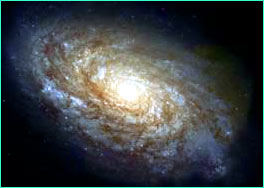
It is so vast that it takes a beam of light (which travels some 700 million
miles per hour) over 100,000 years just to cover the length of our galaxy
called the Milky Way. But our galaxy is only one among billions in the known
universe. To illustrate the size of our universe, consider the following four
examples.
Paper stack model
Let us say the thickness of a sheet of paper represents the distance from the earth to the sun (93,000,000 million miles, (one AU or Astronomical Unit)). To represent the distance to the nearest star we would need a seventy-one foot high stack of paper. To cover the diameter of our Milky Way galaxy would require a 310 Mile high stack. And to reach the edge of the known universe would demand a pile of paper sheets thirty-one Million miles high!
Orange and Grain of Sand Model
Here, an orange will represent the sun. A grain of sand is the earth, circling the orange at a distance of thirty feet. Pluto (the most remote planet in our solar system) is another grain of sand (albeit a smaller grain), circling the orange a mere 10 city blocks away or about 1 mile. Alpha Centauri (the nearest star to earth) is 1300 miles away from the orange (and that is the closest star!).
Hollow Sun Model
If the sun were hollow, one million, three hundred thousand earths could fit inside. A star named Antares (if hollow) could hold sixty-four million of our suns. In the constellation of Hercules there is a star which could contain 100 million of Antares. The largest known star, Epsilon, could easily swallow up several million stars the size of the one in Hercules!  This is just my guess and I don't know how accurate it is but I think Epsilon would be about the diameter of Mercury's orbit.
Relative speed model
Our earth is traveling around its own axis at 1000 miles per hour. It moves around the sun at 67,000 miles per hour (our orbit takes 365 days to complete). Our solar system (all 9 planets) is carried by the sun across our galaxy at a speed of 64,000 miles per hour. Our solar system orbits around our galaxy at 481,000 miles per hour. Our galaxy (the Milky Way) travels though space at one million, three hundred and fifty thousand miles per hour. >>Ever 24 hours we cover 57 million, 360 thousand miles. Every year we travel 20 billion, 936 million, 400 thousand miles across empty space<< And in space terms that's a single celled amoeba crawling compared to a jet zooming at mach 2.
How minute is our universe?
Simply stated, it is as unbelievably small as it is big. Consider the following:
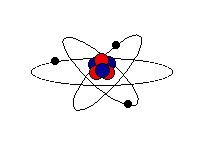
All material in the universe consists of atoms. Atoms in turn are made up of
three "building blocks," which are protons, and neutrons (which two
go to makeup the center of an atom called the nucleus), and electrons (which
circle the nucleus as our earth does the sun).
On the tip of a ball point pen are so many atoms that if they were carried by an army, marching four abreast, an atom to a man, it would take over 20,000 years for the parade to march past. It would take 25 trillion protons laid side by side to span a linear inch.
There are as many protons in a cubic inch of copper as there are drops of water in the oceans of the world, or grains of sand on all the seashores of earth.
The size of an electron is to a dust speck as the dust speck is to the entire earth.
The space between an electron and the nucleus is 10,000 times as great as the size of that nucleus. For example, if the outer shell of electrons in an atom were the size of the Houston Astrodome, the nucleus would be the size of a ping-pong ball in the center of that stadium. Question: If most of the atom is empty space, why does a tabletop offer so much resistance when you push at it with your finger?
Answer: The surface of the table (like the tip of one's finger) consists of a wall of electrons, belonging to the outermost layer of atoms in both objects. Both the speed and force attraction of these electrons thus prohibit your finger from going through the table, as a fast-moving bicycle wheel would prevent you from placing your finger through the spokes.
How much energy exists within our universe?
The protons and neutrons within the nucleus of an atom are held together with a density of one billion tons per cubic inch. This is around forty pounds of energy between each proton.
This energy force is one followed by thirty-eight zeros times stronger than regular gravitational forces. How big is this number? It is over 100 trillion times larger than the number of all the grains of sand on earth's seashores.
German physicist Otto Gail has calculated that a single drop of gasoline, if totally utilized in an automobile, would be sufficient for 400 journeys around the world (a trip of ten million miles).
Albert Einstein estimated the total amount of energy released from one ounce of water could easily lift 200 million tons of steel one mile above the earth.
The various stars and galaxies were created by the conversion of energy into mass. It has been determined that the amount of energy used in the creation of only one gram of matter (1/450th of a pound) is equal to 2.5 times the amount of energy generated by Niagara Falls in one entire day. This would be ten million kilowatts.
What mysterious secrets lie within our universe?
A prominent scientist once said that man's universe is both unknown and unknowable. Consider:
Quasars: These are light sources discovered by Dr. M. Schmidt of the California Institute of Technology in 1963. They are relatively small; yet produce more energy than a cluster of ten trillion stars!
Super novas: These are stars that suddenly increase their luminosity (brightness) by more than 10 million times.
Neutron stars: This is a star that implodes (falls in on itself) rather than exploding. The gravitational forces would crush the atoms into nuclear particles called neutrons. A neutron star would have an unbelievable density, as a teaspoon of its material would weigh a billion tons on earth. In fact, its weight would be sufficient to drive itself all the way through our earth if we collapsed the whole earth to neutron star density, it would be approximately 300 feet in diameter. If you took all the human beings in the world today and put them in one raindrop, you would have such density as exists in a neutron star.
Black holes: A black hole occurs when an imploding star continues beyond the neutron stage. Its gravitational forces thus become so strong that even light itself cannot escape. Dr. Kip Thorne, of the Calif. Institute of Technology, writes:
"A black hole is the end product of the catastrophic collapse of a really large star, the ultimate concentration of matter. We believe a black hole is an extremely smooth structure; it can never have ripples or mountains. Anything it traps can never escape. The black hole can neither split nor decrease in size; it can only grow, and nothing can prevent it from growing. Ultimately if the universe itself does not collapse and die first the black holes will eat up all the matter in our galaxy. Already, as much as one ten thousandth of the universe might be down black holes. We would like to sweep this fact under the rug, but occasionally we drag it out and look it in the face and shudder." National Geographic, May 1974)
Top Home
Last updated on October 3, 2002 at 9:48pm Central Standard Time